
Every few months someone declares SEO dead. They are wrong, but the people who think nothing has changed are wrong too. Here is a clear-eyed look at what SEO fundamentals still do, what has actually shifted, and where SEO fits in an AI-driven search world.
Is SEO dead in 2026?
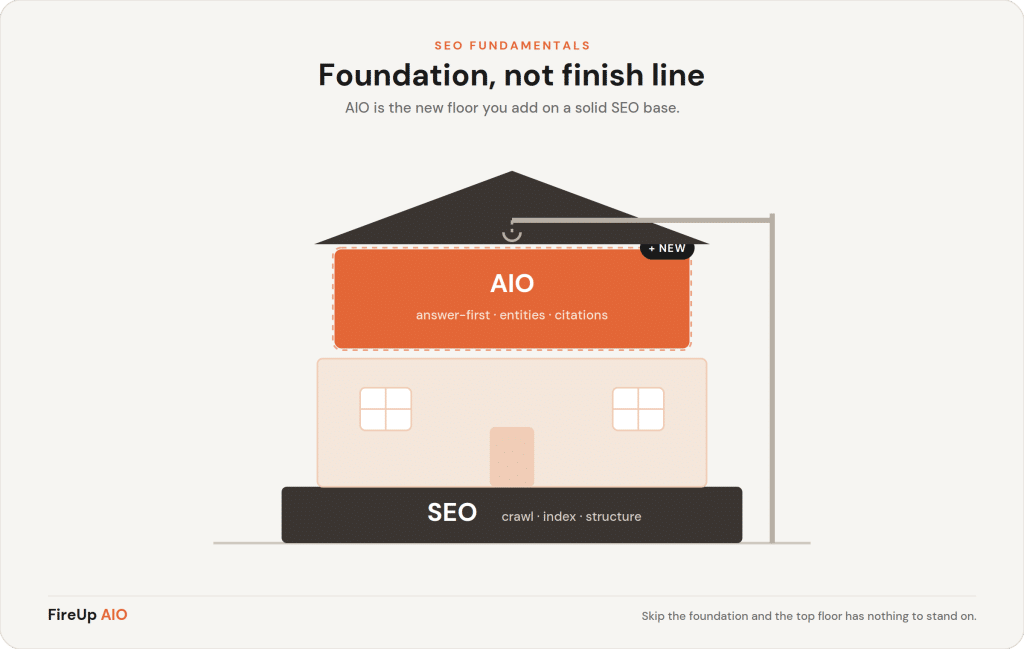
No. SEO is not dead, but it is no longer the whole strategy. The fundamentals that make a site crawlable, structured, and authoritative are exactly what AI tools read to decide who to cite. SEO has become the foundation that AI visibility is built on, not the finish line it used to be.
The “SEO is dead” headline comes back every time search changes, and it is always wrong for the same reason. Search engines and AI tools both need to find your content, understand it, and judge whether it is trustworthy. That is what SEO has always done. What dies is not SEO. It is the narrow version of SEO that treated rankings and clicks as the only scoreboard.
If you want the groundwork, our guide to SEO basics every business should know still holds. This post is about what sits on top of those basics now.
SEO is not dead. The strategy layered on top of it is what changed. Strong fundamentals are now the price of entry for AI to read and trust you at all.
What's actually changed about SEO?
What changed is the goal on top of the fundamentals. SEO used to end at ranking and clicks. Now the same technical groundwork feeds a second goal: being read, trusted, and cited by AI tools that answer buyers directly. The foundation is the same. The destination moved from a blue link to a recommendation inside an AI answer.
Three shifts matter most. First, intent got sharper, because AI rewards content that answers the actual question, not content stuffed with keywords. Second, entities matter more than ever, because AI builds trust by confirming who you are across the web. Third, the payoff moved earlier in the journey, because the buyer often decides during research, before any click. The vocabulary for all of this is in our explainer on AEO, GEO, and AIO.
You can be cited without ranking in the top three
When ChatGPT cites a web page, that page sits in traditional organic positions 21 or lower almost 90% of the time, according to Semrush. Strong fundamentals still help you get cited, but citation is a separate prize that smaller businesses can win even without a number one ranking.
Source: Semrush AI search study
Where does SEO still matter for AI visibility?
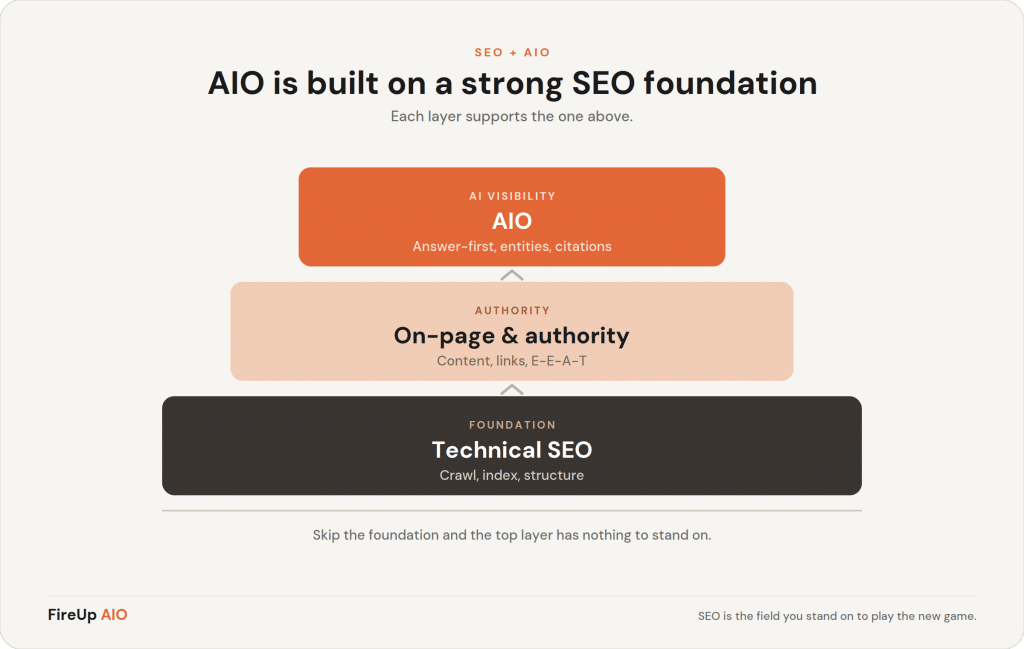
SEO still matters everywhere AI has to find and understand you. If your site cannot be crawled, your content is not structured, or your authority is thin, AI has nothing clean to read and no reason to trust you. The fundamentals are not optional add-ons to AI visibility. They are the conditions that make it possible.
- Crawlability and indexing. If search engines cannot reach a page, AI tools that lean on their index cannot use it either.
- Site structure and internal links. Clear structure helps both crawlers and models understand how your content connects.
- On-page clarity. Real headings, clean HTML, and direct answers are readable by engines and by AI alike.
- Authority and E-E-A-T. The trust signals that helped you rank are the same ones AI checks before citing you.
Our walkthrough of technical SEO foundations covers the groundwork, and our SEO services page explains how we handle it for clients.
How do SEO and AIO fit together?
They fit as foundation and structure. SEO makes your site findable, readable, and credible. AIO takes that readable, credible site and shapes it into answers AI wants to quote and recommend. You cannot skip the foundation and expect the top floor to stand. You also cannot stop at the foundation and expect to win modern search.
| SEO | AIO | |
|---|---|---|
| Primary goal | Rank and earn clicks in search engines | Get read, trusted, and cited by AI tools |
| Optimizes for | Crawlers, rankings, click-through | Extraction, entity trust, citation |
| Content style | Keyword-aligned, comprehensive | Answer-first, specific, verifiable |
| Where it pays off | The click | Before the click, in the recommendation |
| Relationship | Shared foundation; AIO is layered on top of strong SEO | |
Is your foundation ready for AI search?
The free AI Visibility Scorecard checks 16 signals, from fundamentals to citation-readiness.
What should you stop and start doing?
Stop chasing rankings as the only goal and stop treating SEO and AI search as a choice. Start by keeping your fundamentals strong and layering answer-first, citation-ready content on top. The businesses that struggle are the ones picking sides. The ones that win treat SEO and AIO as one connected system.
- Stop measuring success by rankings alone, when buyers increasingly decide before they click.
- Stop publishing keyword-stuffed pages that read well to a crawler and poorly to a human or a model.
- Start leading every page with a direct answer to a real buyer question.
- Start reinforcing your identity and authority so AI is confident enough to cite you.
The full system that ties fundamentals to AI citation is laid out in the AIO Playbook.
SEO is not the game anymore. It is the field you have to be standing on to play the new one.
Key Takeaways
- SEO is not dead. The narrow, rankings-only version of it is fading.
- The same fundamentals that helped you rank are what AI reads to decide who to cite.
- AIO is layered on top of strong SEO, not a replacement for it.
- Stop picking sides. Treat SEO and AI search as one connected system.
Frequently Asked Questions
Is SEO dead in 2026?
No. SEO is not dead, but it is no longer the whole strategy. The fundamentals that make a site crawlable, structured, and authoritative are exactly what AI tools read to decide who to cite. SEO is now the foundation that AI visibility is built on, not the finish line.
What is the difference between SEO and AIO?
SEO optimizes a site to rank and earn clicks in search engines. AIO, or AI search optimization, optimizes it to be read, trusted, and cited by AI tools like ChatGPT and Google’s AI Overviews. They share a technical foundation, but AIO adds answer-first content, entity clarity, and citation-worthiness on top.
Should I stop investing in SEO and only do AIO?
No, because AIO depends on SEO fundamentals to work. If your site is not crawlable, structured, and credible, AI has nothing clean to read or trust. Keep the SEO foundation strong and layer AI search optimization on top, rather than treating them as competing choices.