
AI is the new front door for buyer research. The businesses getting recommended are not the ones publishing the most. They are the ones AI can understand, trust, and reuse with confidence. This playbook covers how AI chooses who to cite, the six signals that get you sourced, the questions everyone is asking right now (llms.txt, AI crawlers, tracking, AI shopping agents), and what is no longer worth your time in 2026. I help established businesses become the ones AI recommends. This is the thinking behind it.
How has search changed in 2026?
Search has shifted from earning rankings to earning citations. Buyers get answers from AI Overviews, ChatGPT, and Perplexity, often without clicking a single result. AI did not kill SEO. It changed the win condition. Winning now means being the source AI quotes, not one of the ten blue links it ranks.
Look at how people buy now. You check review sites, compare options, weigh proof. AI gathers that same information in a fraction of the time, so buyers now let AI do the comparison for them. The signals that influence buying decisions today are the ones AI uses.
The numbers behind the shift:
Zero-click is the default. Roughly 60% of US Google searches end without a click. With AI Overviews present, organic click-through drops 61% (Seer Interactive). Inside Google AI Mode, around 93% of sessions end without a click.
The clicks that survive are worth more. AI-driven visitors are 4.4x more valuable than traditional organic visitors (Semrush), and 90% of buyers click through to sources cited in AI Overviews (TrustRadius).
The money is moving. McKinsey projects $750 billion in US revenue will flow through AI search by 2028. Gartner projected traditional search volume drops 25% by 2026, and it is tracking.
Visibility is no longer just your website. AI pulls from your site, reviews, listings, community posts, and press, then cross-checks them against each other.
The best framing I can give you: AI search right now is like Google SEO in 2003. The playbook is being written in real time, and the businesses that move early own this channel for the next decade.
The old question was how do I rank. The 2026 question is different: when a buyer asks AI who to trust, what has to be true for my business to be the name it gives?
What does this look like with a real business?
Here is first-party data from one of my clients, Tyler Madison, a US manufacturing company. Last month, visitors who arrived from AI tools stayed longer and took more actions than visitors from any other source. AI did not just send traffic. It sent people already close to deciding.
The site average for time on site was 41 seconds. Visitors from ChatGPT stayed a full minute. Claude and Gemini visitors stayed two minutes, three times the site average. Against an average of 4.7 actions per visit, Perplexity visitors took six and Copilot visitors took five.
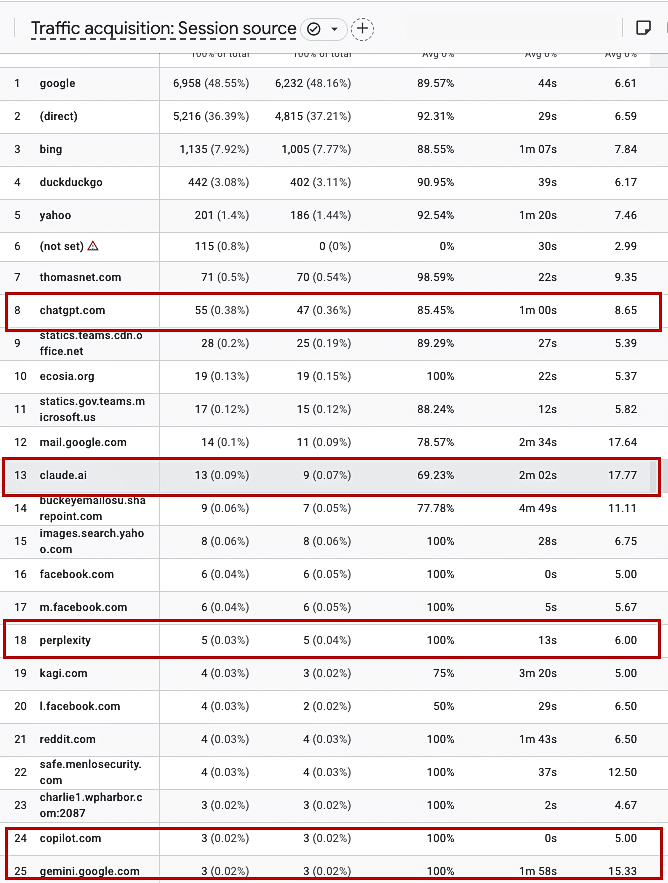
| AI source | Referrals | Avg time on site | Actions per visit |
|---|---|---|---|
| Site average (all sources) | — | 41 seconds | 4.7 |
| ChatGPT | 55 | 1 minute | — |
| Claude | 13 | 2 minutes | — |
| Gemini | 3 | 2 minutes | — |
| Perplexity | 5 | — | 6 |
| Copilot | 3 | — | 5 |
The referral counts are small, this is one month from one mid-sized manufacturer, not a national study. But the pattern is the point, and it matches what the broader data predicts: AI sends fewer visitors, and those visitors are worth more.
This is why AI visibility is not a vanity metric. It is the difference between being found by someone comparing options and being skipped entirely while AI recommends a competitor.
What is AIO, and how is it different from SEO, AEO, and GEO?
AIO (AI Search Optimization) is the work of making your business easy for AI to understand, trust, and recommend. In plain English: SEO gets you ranked. AIO gets you recommended.
| Feature | Traditional SEO | AI Search Optimization (AIO) |
|---|---|---|
| Main goal | Rank higher on the search results page | Be the source AI cites and recommends in the answer |
| Primary focus | Keywords and backlinks | Entity clarity, structured answers, and proof |
| Win condition | A blue link in the top results | A named citation inside the AI answer |
| Buyer action | Clicks a link to visit your site | Reads the answer, then chooses who to trust |
| Credibility signal | Backlink volume and domain authority | Third-party mentions and consistent entity signals |
| Content that wins | Keyword-targeted pages | Answer-first content AI can understand, trust, and reuse |
The layers split like this:
- SEO gets you indexed and ranked. Still the foundation, because AI tools pull from indexed content.
- AEO (answer engine optimization) gets your words pulled into the answer through clean FAQs, definitions, and schema.
- GEO (generative engine optimization) gets your business chosen through mentions, citations, and consistency across the web.
- AIO ties it all together so AI has one clear, confident picture of you across the whole web.
For the rest of this playbook, when I say AIO, I mean the whole approach.
How does AI decide who to cite or recommend?
AI runs every potential source through three filters: can it understand you, can it trust you, and can it reuse your information safely. Win all three and you get cited. Here is the mental model: understand, trust, reuse.
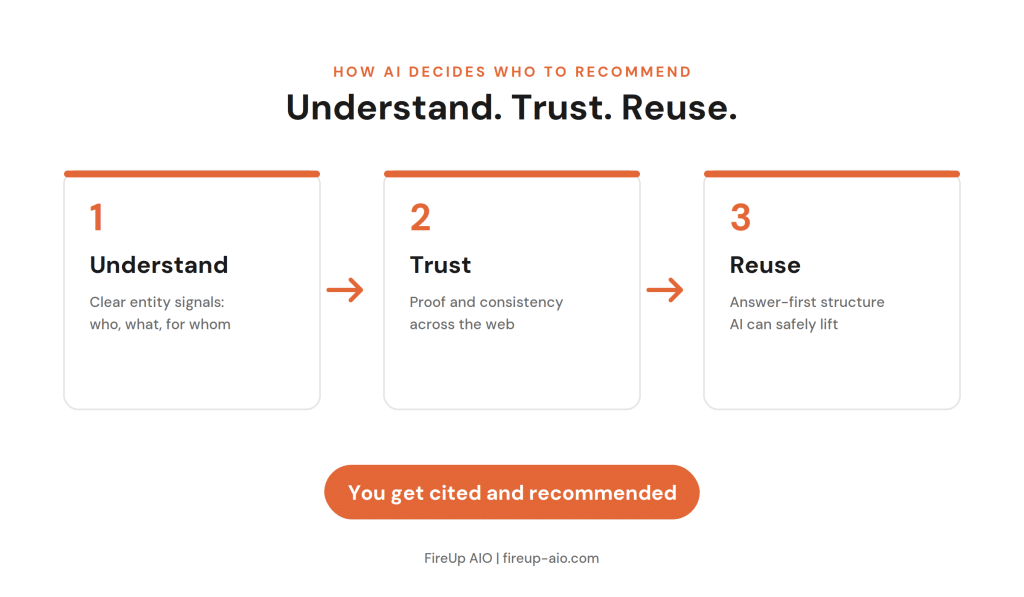
1. Understand
AI first has to understand who you are and what you are about. This is entity work, not keyword work. An entity is a thing AI recognizes: your business, services, location, founder, and the problems you solve. AI needs clear answers to four questions: who are you, what do you do, who is it for, and why should anyone trust you.
Specifics beat generalities. AI already has plenty of generic content. It cites niche audiences served, real company data, named people, and unique perspectives.
FAST TEST
Could a stranger describe your offer in one sentence after reading your homepage hero? If not, that is step one.
2. Trust
Then AI has to trust you, so it looks for authority signals and evidence across outside sources like review sites, directories, and press. Consistency is everything here. Your factual claims, messaging, services, and service area must align across your site and external profiles. Mismatches make AI doubt the source.
86% of AI citations come from brand-controlled content
Websites and listings you control, not forums, drive the majority of AI citations. You own more of this than the Reddit hype suggests.
Source: Yext, 2026
3. Reuse
Finally, AI needs to be able to use you. Your information must be easy to extract and safe to repeat. AI scans content looking for direct answers to lift. Lead with the answer, then add supporting context and topical depth. Each section should answer one clear buyer question.
When you win these three, you get cited and recommended.
What does AI actually cite?
AI cites content that already answers the exact question in a structure it can lift, then cross-checks the source against sites it already trusts. When AI surfaces a business, it pulls from a consistent set of signals:
- Named entities. People, companies, specific role titles, locations.
- Concrete numbers. Years in business, results, team size, awards.
- Geographic specificity. City, state, region, defined service area.
- Real stories with verifiable details. Founder story, milestones, named team members.
- Structured FAQs answering common buyer questions.
- Third-party validation. Review volume, ratings, press mentions, case studies.
- Content structure. Direct answers, supporting context, and enough topical depth to feel complete.
On format: comprehensive pages beat thin posts, simple language beats jargon, a full topical cluster beats one isolated page, and your own data or real examples beat recycled advice. One more shift in 2026: comparison content wins. Buyers ask AI which option to choose, so pages that help people compare, evaluate, and decide get cited in commercial queries far more than purely informational posts.
On trust surfaces: AI leans on large community and review platforms because they have reach and are easy to validate. Do not try to be everywhere. Pick two or three trust surfaces your buyers actually use, the publications, niche blogs, and review sites for your industry, and earn a few high-signal mentions there.
What are the signals that get you sourced?
Six signals show up consistently across every citation study and every audit I run. They are the basis of my FIREUP Framework, weighted by how much each one drives citations:
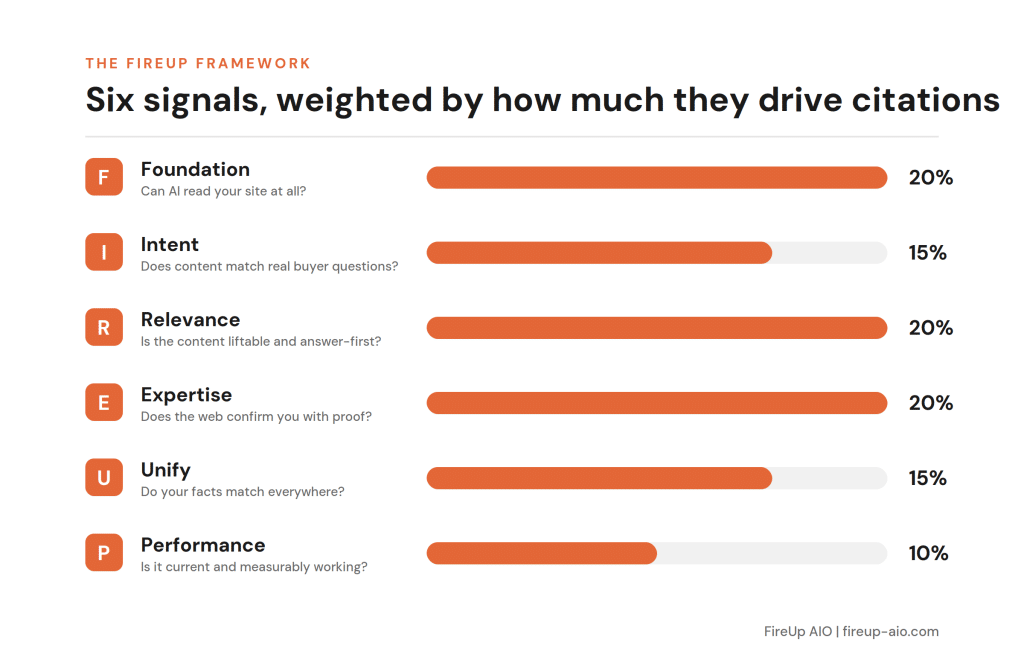
- Eligibility (Foundation, 20%). Can AI crawlers read your site at all? Crawl access, speed, clean rendering, schema.
- Intent match (Intent, 15%). Does your content answer the questions buyers actually ask AI, in their words?
- Extractable structure (Relevance, 20%). Is the content liftable? Answer-first sections, descriptive headers, one intent per page.
- Proof (Expertise, 20%). Does the web confirm you? Reviews, case studies, credentials, third-party mentions.
- Consistency (Unify, 15%). Do your facts match across your site and every external profile?
- Freshness and outcomes (Performance, 10%). Is the content current, and is it measurably producing visibility?
Worked in that order. Foundation gets you seen, Intent gets you chosen, Relevance gets you used, and Expertise gets you trusted.
Want to See Where Your AI Visibility Stands?
Take the free AI Visibility Scorecard. Enter your URL and get scored across all six FIREUP pillars in under 60 seconds.
The questions everyone is asking right now
These are the most searched AIO questions of 2026. Direct answers, no hedging.
Does llms.txt actually work?
Not as a citation driver. llms.txt is a markdown file that helps AI agents navigate your site during a session. It does not control training, it does not block crawlers, and Google has said on record it does not support it. Crawler log studies show AI bots rarely request the file. If your platform generates one in a click, fine, add it. Do not spend budget on it, and do not let anyone sell it to you as an AI visibility fix. Clear pages and schema move citations. llms.txt does not.
Should I block AI crawlers?
If you want AI visibility, no. Blocking GPTBot, ClaudeBot, PerplexityBot, or Google-Extended removes you from the answer layer where buyers now decide. Keep crawler access controlled by your robots.txt and origin server, not a proxy or firewall that blocks bots by default. Many businesses are invisible to AI not because of their content but because their CDN or security settings quietly block AI crawlers. Check your settings before you touch your content.
How do I know if AI is sending me traffic?
Your analytics are probably lying to you. Around 70% of AI referrals show up in standard GA4 setups as direct traffic because tools like paid ChatGPT do not pass referrer data. Two fixes: build a custom GA4 channel group that captures known AI sources, and run your top buyer questions through ChatGPT, Google AI Mode, and Perplexity monthly. Note whether an AI answer appears, who gets cited, and what is missing. That manual check is still the most reliable visibility read available.
What about AI shopping agents and Instant Checkout?
Agentic commerce is real and early. ChatGPT now completes purchases inside the chat, Google launched checkout inside AI Mode, and McKinsey projects AI agents could mediate trillions in consumer commerce by 2030. For service businesses, the takeaway is simpler than the hype: AI agents choose vendors using the same understand, trust, reuse filters described above. The work you do now to get cited is the same work that gets you chosen by an agent later. No separate playbook needed yet.
What is no longer worth your time in 2026?
AI does not reward effort or volume. It rewards clarity. If it cannot quickly classify, extract, and trust you, it moves on. Not because you are bad, but because you are unclear. Stop spending time on:
- Chasing every new AI tool or trend instead of getting the fundamentals right.
- Publishing content with no specific buyer question behind it. AI wants targeted, direct answers, not another five thousand word complete guide.
- Outdated SEO hacks: buying links, keyword-stuffed pages, tiny metadata tweaks, anything built to game an algorithm instead of answering a buyer.
- Treating schema as a magic wand. Schema labels content that is already visible. It is not a workaround for thin pages or missing proof.
- llms.txt as a strategy. See above.
- Vanity metrics with no outcomes attached.
- Letting your information stay inconsistent across the web.
The mindset shift underneath all of this: backlinks are no longer the credibility layer. Third-party mentions are. Citation research suggests brand search volume now predicts AI citations more reliably than backlinks do. Traditional SEO rewarded optimization. AI search rewards clarity and classification.
“The businesses that win AI search create the most useful answer for humans and the clearest structure for machines.”
Jacki DeVries, Founder FireUp AIO
The 10-minute self-check
Before you spend a dollar, run this:
- Can a stranger tell what you do in 5 seconds on your homepage?
- Does your top service page answer: what is this, who is it for, how much, how does it work?
- Do you have at least one strong proof element above the fold?
- Do your About, Services, and Location pages clearly connect with links?
- Do your business name, services, and service area match across every external profile?
- Are AI crawlers allowed in (no proxy or firewall silently blocking them)?
If you answered no to any of these, that is your starting point. Fix understanding before trust, and trust before reuse.
SUMMARY
- AI now decides who buyers find and trust. The win condition shifted from ranking to being cited.
- AI cites the sources it can understand, trust, and reuse. Win all three filters and you get named.
- Six weighted signals drive citations, the basis of the FIREUP Framework. Clarity beats volume.
- Skip the noise (llms.txt, link hoarding, schema-as-magic). Start with the free AI Visibility Scorecard.
Where should I start?
Start with the free AI Visibility Scorecard. Enter your URL and in under 60 seconds it scores your visibility across all six FIREUP pillars and shows your highest-leverage fixes. From there, the AI Visibility Audit is the full diagnostic, with competitive intelligence and live AI testing that automation cannot replicate, and the Implementation Plan turns it into shipped work.
FAQs
What is AIO?
AIO (AI Search Optimization) is the practice of structuring your business so AI tools like ChatGPT, Google AI Overviews, and Perplexity can understand, trust, and cite it. SEO gets you ranked. AIO gets you recommended.
How is AIO different from SEO?
SEO targets rankings and clicks. AIO targets citations and recommendations inside AI answers. AIO builds on SEO by adding entity clarity, answer-first content, and proof signals that AI uses to decide who to name.
How does AI decide who to recommend?
AI runs you through three filters: can it understand you, can it trust you, and can it reuse your information safely. Understanding comes from clear entity signals, trust from proof, and reuse from clean structure. Win all three and you get cited.
Is SEO dead?
No. SEO is the foundation AIO is built on, because AI tools still pull from indexed content. What changed is the win condition: being cited in the answer now matters more than ranking below it.
Do I need to be a big business for AIO to work?
No. Specificity wins, so focused expert businesses often get cited faster than larger competitors. If your information is clear, structured, and verifiable, AI can treat you as a trusted source even with a small domain.
How fast can I see results from AIO?
Most businesses see early signals within 30 to 60 days, like first mentions in AI tools. Meaningful traction usually shows over 3 to 6 months, depending on your starting point and competition.
Does llms.txt help with AI visibility?
No. llms.txt is a navigation file for AI agents, not a citation or ranking signal. Google has confirmed it does not use it, and crawler studies show AI bots rarely request it.
Should I block AI crawlers from my website?
Not if you want AI visibility. Blocking GPTBot, ClaudeBot, PerplexityBot, or Google-Extended removes you from AI answers entirely. Check that your CDN or firewall is not silently blocking them by default.
Do I need schema for AIO?
Yes, but as labels for visible content, not as a hack. Schema like FAQPage, Article, and Service helps AI parse your page. It reflects what is visible. It never replaces it.
Are backlinks still the credibility signal?
Not the way they were. Third-party mentions on sources AI trusts now carry more weight, and brand search volume appears to predict citations more reliably than backlinks. Earn a few high-signal mentions instead of chasing link volume.
How do I know if AI is recommending my business?
Run your top buyer questions in Google, ChatGPT, and Perplexity each month, and note who gets cited. Also fix your analytics, since most AI referral traffic shows as direct in GA4 without a custom channel group.
What is zero-click search?
Zero-click search is when buyers get their answer from the AI summary without clicking any result. It is now the dominant behavior for informational queries, which shifts the win from earning the click to being named in the answer.