

Most “AI optimization” advice fixates on content and keywords and ignores everything else AI weighs. The FIREUP Framework maps the six pillars AI uses to decide who to cite, and shows why advice that covers two of them leaves you invisible on the other four.
What is the FIREUP Framework?
The FIREUP Framework is a six-pillar model that maps how AI tools decide who to cite and recommend. The pillars are Foundation, Intent, Relevance, Expertise, Unify, and Performance. Each one covers a distinct signal AI weighs, from whether it can technically read your site to whether the wider web confirms you are credible. Together they turn scattered tactics into one system.
It exists because AI does not make a single judgment about your business. It makes several, in sequence, and a weakness in any one can keep you out of the answer. A site can have brilliant content and still go uncited because AI cannot read its structure, cannot verify its identity, or cannot find any proof of credibility. The framework names each judgment so you can see exactly where you are strong and where you disappear. The full model lives on the FIREUP Framework page.
AI does not score you on one thing. It scores you across six distinct signals, and a gap in any single pillar can keep you out of the answer entirely.
Why is most AI marketing advice wrong?
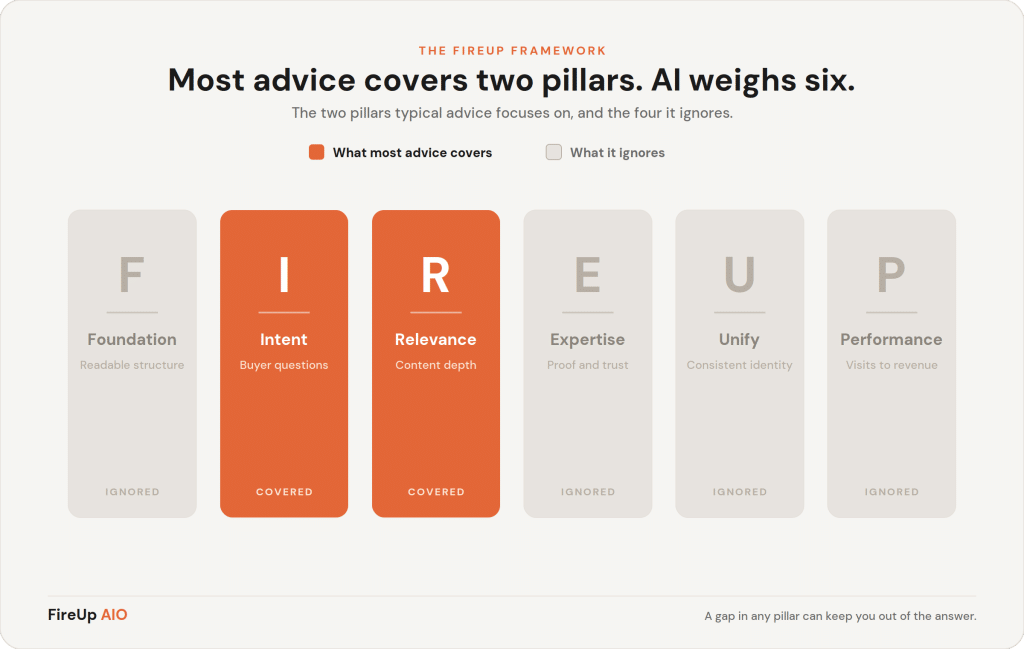
Most AI marketing advice is wrong because it optimizes one or two pillars and ignores the other four. The typical advice is “write more content” and “use the right keywords,” which touches Relevance and Intent. It says almost nothing about the technical foundation AI needs to read you, the credibility it needs to trust you, the identity consistency it needs to confirm you, or the performance that turns visibility into revenue.
That is why so many businesses follow the advice, publish more, and see nothing change. They poured effort into one pillar while four others stayed broken. AI still could not read their structure, still could not verify who they were, and still found no proof they were credible. More content does not fix a foundation problem. It just adds floors to a building with no footing.
You can do everything the “AI optimization” articles tell you and still be invisible, because they are describing one pillar out of six.
What are the six pillars AI weighs?
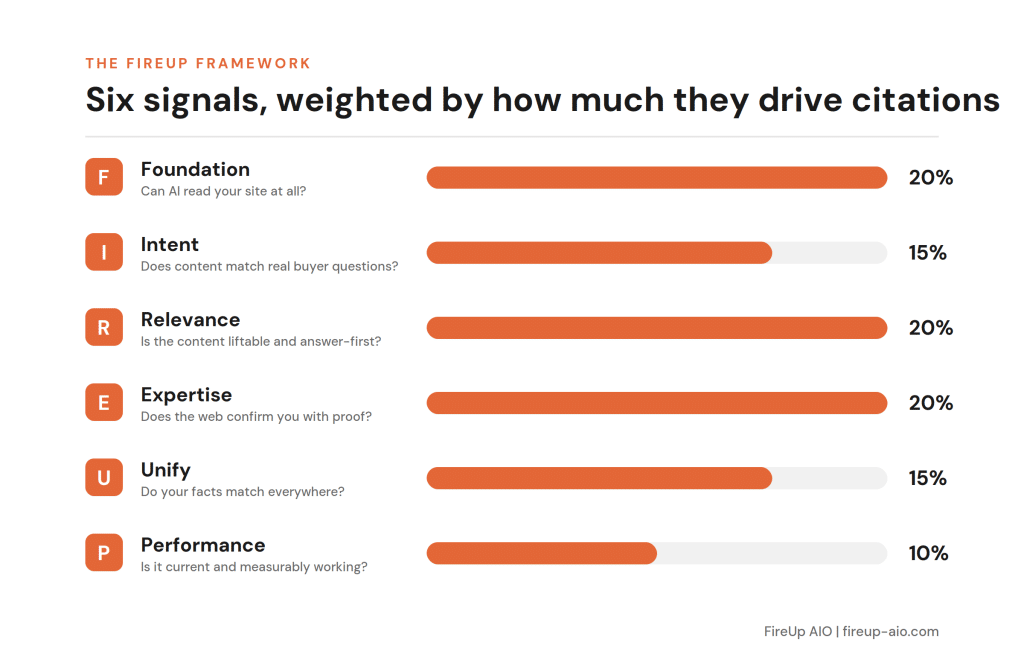
The six pillars are Foundation, Intent, Relevance, Expertise, Unify, and Performance. Foundation makes you readable. Intent makes you relevant to the actual question. Relevance gives depth to the answer. Expertise makes you trustworthy. Unify makes you verifiable across the web. Performance turns visibility into results. Each carries its own weight in how AI decides.
| Pillar | What it covers | Relative weight |
|---|---|---|
| F — Foundation | The technical groundwork that makes a site readable: crawlability, clean structure, schema, semantic HTML. | Highest tier |
| I — Intent | Matching the real questions buyers ask, in the words they use, at the moment they ask them. | Mid tier |
| R — Relevance | Content depth and topical coverage that actually answers the query, not just mentions it. | Highest tier |
| E — Expertise | The credibility AI verifies before citing you: authorship, proof, experience, E-E-A-T. | Highest tier |
| U — Unify | Consistent identity across the web so AI can confirm who you are with confidence. | Mid tier |
| P — Performance | Speed, experience, and conversion readiness that turn visibility into measurable results. | Supporting |
Which pillars does most advice miss entirely?
Most advice misses Foundation, Expertise, Unify, and Performance. It lives almost entirely in Relevance and Intent, telling you to publish more and target better keywords, while staying silent on whether AI can read your site, trust your credibility, confirm your identity, or convert the visibility you earn. That is four of six pillars left unattended.
| Pillar | Covered by typical advice? | What gets missed |
|---|---|---|
| Foundation | Rarely | Whether AI can technically read and parse your pages at all |
| Intent | Partly | Matching real buyer questions, not just keyword volume |
| Relevance | Yes | This is where most advice stops |
| Expertise | Rarely | The proof and authorship AI checks before citing you |
| Unify | Almost never | Consistent identity AI uses to confirm who you are |
| Performance | Almost never | Turning visibility into leads and revenue |
This is the difference between adding tactics and building a system. Our B2B manufacturing case study shows what happens when all six pillars get attention: a business that was cited by one AI engine ended up cited across all five.
Want to see your score across all six pillars?
The free AI Visibility Scorecard checks 16 signals mapped to the FIREUP Framework.
How do you use the FIREUP Framework?
You use it as a diagnostic before you use it as a plan. First find out which pillars are strong and which are quietly costing you citations, then fix the weakest pillars in order of impact. Adding more of what you are already good at rarely helps. Closing the gaps AI is penalizing you for almost always does.
- Diagnose first. The AI Visibility Scorecard gives you a fast read across all six pillars and your top five fixes.
- Go deep where it counts. The AI Visibility Audit turns the diagnostic into prioritized findings for your specific site.
- Fix in order of impact. Start with the pillar holding everything else back, usually Foundation or Expertise, not more content.
The complete walkthrough, with examples, is in the AIO Playbook.
Key Takeaways
- AI scores you across six pillars: Foundation, Intent, Relevance, Expertise, Unify, Performance.
- Most advice covers only Relevance and Intent, leaving four pillars unaddressed.
- A gap in any single pillar can keep you out of AI answers entirely.
- Diagnose first, then fix the weakest pillar by impact, instead of adding more content.
Frequently Asked Questions
What is the FIREUP Framework?
The FIREUP Framework is a six-pillar model that maps how AI tools decide who to cite and recommend: Foundation, Intent, Relevance, Expertise, Unify, and Performance. Each pillar covers a distinct signal AI weighs, from technical readability to verified credibility. It turns scattered AI optimization tactics into one connected system.
Why is most AI optimization advice wrong?
Most advice focuses on content and keywords, which is one or two pillars, and ignores the rest. It skips the technical foundation AI needs to read you, the credibility signals it needs to trust you, the identity consistency it needs to confirm you, and the performance signals that turn visibility into revenue. Optimizing one pillar while ignoring four leaves most of the score on the table.
What are the six pillars of the FIREUP Framework?
Foundation is the technical groundwork that makes a site readable. Intent is matching real buyer questions. Relevance is content depth that answers them. Expertise is the credibility AI verifies before citing you. Unify is consistent identity across the web. Performance is the speed, experience, and conversion readiness that turn visibility into results.