

FireUp SEO » Internet Marketing Blog » Search Engine Optimization » SEO Fundamentals in an AI Search World: Basics to Know for 2026

SEO Fundamentals in an AI Search World: Basics to Know for 2026

Jacki 18 min read Aug 28, 2025

What is Search Engine Optimization (SEO?)

Every company has a different way of saying the same thing – this is the way I explained it to my husband who sells industrial coding and labeling packaging equipment: SEO is about getting your website to the top of the search results on google, bing and other search engines for keywords and topics that are relevant to your business, with the result (ideally) being this: if you rank higher you’ll get more targeted traffic, which will ultimately lead to more conversion and sales.

The formal definition per Google:

Search engine optimization (SEO) is about helping search engines understand your content, and helping users find your site and make a decision about whether they should visit your site through a search engine.

They do a great job of explaining the subject in their SEO Starter Guide and the key elements of SEO with their Search Essentials outline. Both are excellent resources for beginners wanting to learn more about SEO — from the source.

This article provides an overview of the core parts that make up SEO, how AI search (AIO) is changing SEO in 2026, pro tips from the experts, SEO basics you can implement right now, and more.


If you’d rather have a partner handle the heavy lifting, you can always explore my SEO services to see how I help businesses build and maintain a stronger search foundation.

Key SEO Stats for 2026

  • Google holds 90%+ of global market share Statscounter
  • Google uses 200+ factors in its algorithm for ranking websites Backlinko
  • 49% of marketers report that organic search has the best ROI of any marketing channel Search Engine Journal
  • Less than 25% of users go past the first page of search results SEOProfy
  • The top three organic results receive roughly 68.7% of all clicks Backlinko
  • SEO is responsible for 34% of all qualified leads Chad Wyatt
  • Organic search drives 44.6% of total revenue across industries. Chad Wyatt

Want to see how your business stacks up in today’s search landscape?

Explore my AI search optimization (AIO) framework

Get Your AI Visibility Score

How Does SEO Work?

Google is basically a robot that uses crawlers to continuously scan the web and index new pages. It’s this “Googlebot” that uses an algorithmic process to determine which sites to crawl, how often, and how many pages to fetch from each site. Google’s crawlers are also programmed such that they try not to crawl the site too fast to avoid overloading it. For a more in depth look into how Google search works, you can check out Google’s In-Depth Guide to How Google Search Works.

Going back to our house, the foundation planning and layout is arguably the most important element of building a home. It will dictate the rest of the project including what you’re able to do or build in your space. Everyone wants a well planned out and structurally sound foundation to build on, and SEO is the same.

At the end of the day search engines read code — they must be able to crawl, render, and index the pages on your website without issues. With the millions of websites and competitors out there this is in my opinion the most important, but often most forgotten or incorrectly executed element of SEO.

Even if you have the best content and user experience, if the foundational elements of your website are messed up it will for certain negatively impact your ability to rank.

Google says that you usually don’t need to do anything except publish your site on the web. But the truth of the matter is that with the billions of websites out there, we need to be intentional and implement strategies to improve our rankings and out perform our competitors.

Mark Williamson

If you’re worried your “foundation” might already be cracked—slow pages, crawl issues, or messy architecture—start with my deep dive Building Your Foundation: Technical SEO for a step-by-step checklist. And if you’d rather have an expert evaluate it for you, you can always request a Technical SEO audit so we can spot and prioritize fixes together.


Request a Technical SEO Audit

Keyword Strategy in 2026: Why It Matters

Getting the technical pieces right is only half the battle. To actually show up for the right searches, you need a keyword strategy that matches how people search today—longer, more specific queries, questions, and natural, conversational language.

Instead of chasing vanity keywords like “SEO” or “marketing agency,” you’ll get better results by targeting the high-intent, long-tail phrases your ideal customers are actually typing (or speaking) into search. That’s where the real opportunities live in 2026.

If you want a deeper walkthrough of how to find those phrases, group them into topics, and prioritize what to go after first, check out my full guide: Keyword Strategy in 2026: How to Stay Ahead of the Curve

Learn how to move beyond vanity keywords and build topic-driven clusters that align with how people actually search in 2026—across both traditional results and AI-powered answers.

Read: Keyword Strategy in 2026

How AI Search Is Changing SEO in 2026

Search isn’t just “ten blue links” anymore. When your customers type (or speak) a question into Google, they’re just as likely to see an AI-powered summary, People Also Ask box, or rich result as they are a traditional results page.

That doesn’t mean SEO is dead. It means the job of SEO has expanded.

Instead of only asking, “How do I rank my website?”, we now have to ask, “How do I become the trusted source behind the answer?”

From web pages to answers

AI search experiences (like Google’s AI Overviews and other generative results) pull in information from multiple sources and stitch it into a single response. Behind every one of those answers is:

  • A technically sound website that can be crawled and indexed

  • Clear, well-structured content that directly addresses searcher questions

  • Trusted brands and entities that search engines feel confident referencing

In other words: the same SEO foundations still matter—they’re just being used in more places than the traditional results page.

Why fundamentals still matter (even more now)

You can think of AI search as putting a spotlight on the strongest houses in the neighborhood:

  • If your technical foundation is weak, crawlers struggle to access and understand your content, so you’re less likely to be pulled into AI-generated answers.

  • If your on-page content and structure don’t clearly answer questions, match intent, and demonstrate expertise, AI systems have no reason to “quote” you.

  • If your off-page signals (links, mentions, reviews, citations) are thin, you’re less likely to be considered a trusted authority worth surfacing.

AI search hasn’t replaced SEO. It has raised the bar on what “good SEO” looks like.

Where AIO (AI-first optimization) fits in

This is where AIO—AI search optimization—comes in.

SEO focuses on making your website easy to discover, understand, and trust in search results.
AIO takes it a step further and asks:

  • How will AI systems interpret this page?

  • Does this content answer the question directly, clearly, and in a way that’s easy to reuse?

  • Are we sending consistent signals about who we are, what we do, and why we’re an authority?

When you combine strong SEO fundamentals with AIO thinking, you’re not just fighting for a spot on page one—you’re positioning your business to:

  • Be cited in AI-generated answers

  • Capture clicks and brand visibility in zero-click results

  • Stay visible as search continues to evolve

If you want to go deeper into how to optimize specifically for AI and answer engines, be sure to check out my full AIO Guide to Being Cited in 2026 and 2026 AIO Playbook.

Why is SEO important?

Google says that you usually don’t need to do anything except publish your site on the web. But the truth of the matter is that with the billions of websites out there, we need to be intentional and implement strategies to improve our rankings and out perform our competitors.

Top Benefits of SEO

Here are the top 5 reasons every online business should be doing SEO:

  • Increases Traffic: ORGANIC traffic, which you technically don’t pay for, but earn it.
  • ROI: SEO is one of the highest return on investment channels that exist as far as generating net new visitors are concerned.
  • Great for Brand Awareness: The higher you rank, the more visible you are when people search keywords relevant to your brand.
  • Builds Trust: SEO is essentially Google referring your business to people.
  • The Competition Is Doing It: And of course your competition is doing it and making money from it. We should be getting those clicks and taking some of their market share. And we’ll go into what we learned about a few of your competitors a little later.

To get more in-depth information, you should check out Moz’s Beginners Guide to SEO.

The Building Blocks of Your Digital House

Top SEO Ranking Factors

I like to think of your website’s SEO like building a home. You can’t properly build a house without completing the previous steps, or it won’t stand for long. SEO works the same way. You need three core building blocks:

  1. The Foundation: Technical SEO – how easily search engines can find, crawl, render and index your site.

  2. The Structure: On-Page SEO – your content, keyword targeting, and on-page elements.

  3. The Roof: Off-Page SEO – your authority, links, brand mentions, reviews and overall trust.

Each one plays a crucial role in making sure your digital house is both sturdy and appealing.

The Foundation: Technical SEO

What is Technical SEO?

Technical SEO is similar to laying the foundation of your home. It ensures your website meets the technical requirements necessary for search engines to crawl, render, and index your pages effectively. You wouldn’t start building your house without a solid foundational plan first, right?

What Is Technical SEO important elements

Key Elements of Technical SEO

Site Architecture:

A well-organized site structure helps search engines navigate and index your pages efficiently.

Crawling and Indexing:

Ensuring that search engines can access and index your pages is fundamental.

Mobile Optimization:

Your site must be mobile-friendly to cater to users on various devices.

Page Speed:

Fast-loading pages enhance user experience and can impact your rankings.

Duplicate Content:

Addressing duplicate content issues is essential to avoid penalties.

Among many, many other things.

Key Elements of Technical SEO

Site Architecture: A well-organized site structure helps search engines navigate and index your pages efficiently.

Crawling and Indexing: Ensuring that search engines can access and index your pages is fundamental.

Mobile Optimization: Your site must be mobile-friendly to cater to users on various devices.

Page Speed: Fast-loading pages enhance user experience and can impact your rankings.

Duplicate Content: Addressing duplicate content issues is essential to avoid penalties.

Among many, many other things.

Why is Technical SEO Important?

Going back to our house, the foundation planning and layout is arguably the most important element of building a home. It will dictate the rest of the project including what you’re able to do or build in your space. Everyone wants a well planned out and structurally sound foundation to build on, and SEO is the same.

Search Engines Need to be able to find, crawl and index your website pages
Search Engines need to be able to find, crawl, render and index the pages on your website.

At the end of the day search engines read code — they must be able to crawl, render, and index the pages on your website without issues. With the millions of websites and competitors out there this is in my opinion the most important, but often most forgotten or incorrectly executed element of SEO.

Even if you have the best content and user experience, if the foundational elements of your website are messed up it will for certain negatively impact your ability to rank.

How To improve Technical SEO

Site Architecture

A well-organized site structure helps search engines navigate and index your pages efficiently.

Crawling and Indexing

Ensuring that search engines can access and index your pages is fundamental.

Mobile Optimization

Your site must be mobile-friendly to cater to users on various devices.

Page Speed

Fast-loading pages enhance user experience and can impact your rankings.

Duplicate Content

Addressing duplicate content issues is essential to avoid penalties.

Learn More Abut Building Your Foundation: Technical SEO

The Structure: On-Page SEO

What Is On-Page SEO?

On-page or on-site SEO is like constructing the walls, windows, and interiors of your home. It involves optimizing individual pages to make them search-engine friendly.

Why Is On-Page SEO Important?

A well-structured site with quality content ensures that your pages are valuable to users and search engines alike. It helps establish your site’s relevance and authority on specific topics.

On-page SEO is important because search engines rely on keywords and other on-page SEO elements to determine whether a page matches a user’s search intent.

SEMRush
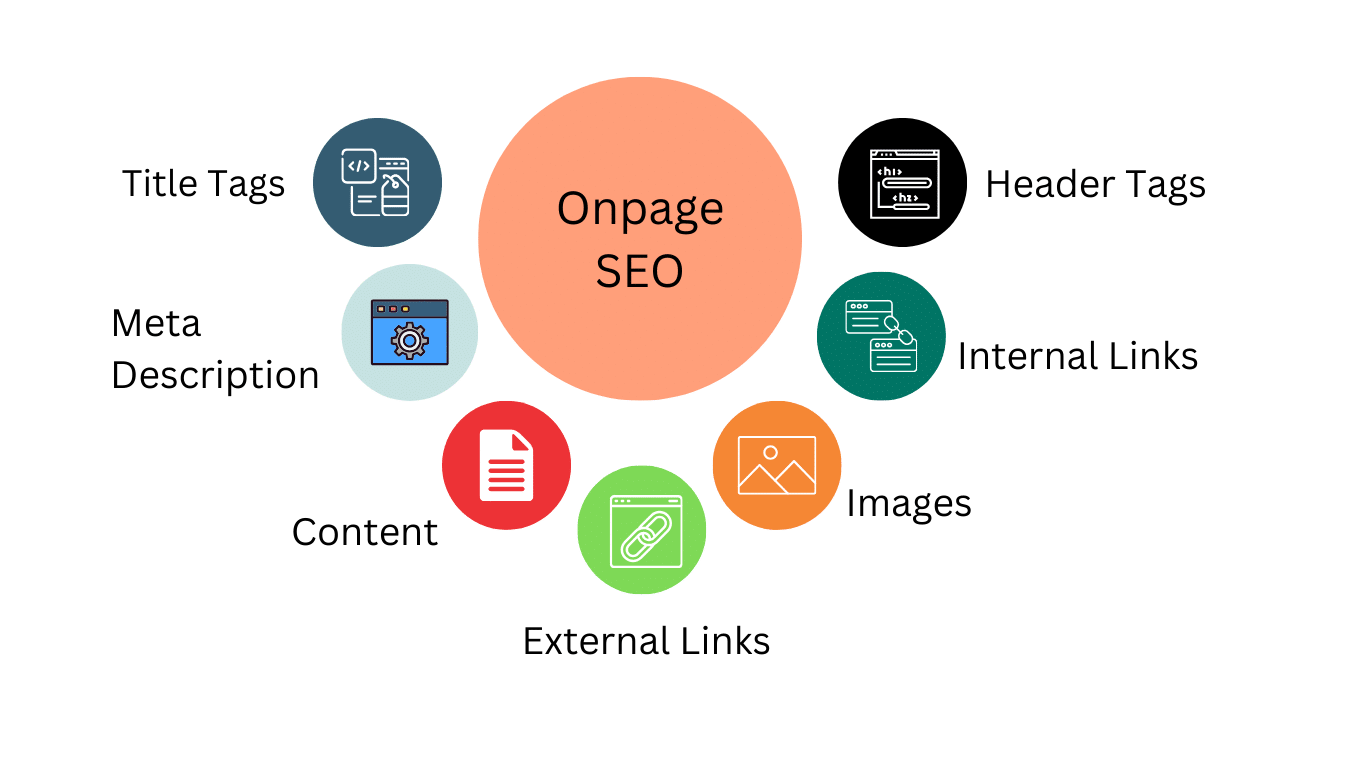
onpage-seo
There are several factors that contribute to on-page SEO

Key Aspects of On-Page SEO

Content Quality: Unique and relevant content is vital for engaging visitors and search engines.

Title Tags and Meta Descriptions: Craft compelling titles and descriptions to improve click-through rates.

Header Tags and Keyword Optimization: Use headers and keywords effectively to enhance readability and relevance.

Internal Linking: Helps distribute page authority and guide visitors through your site.

How To Improve On-Page SEO

  • Craft Unique, High-Quality Content
  • Optimize Title Tags, Meta Descriptions, and Headers
  • Implement a Logical Internal Linking Structure
  • Ensure Mobile-Friendliness

Learn More About On-Page SEO

The Roof: Off-Page SEO

What is Off-Page SEO?

Off-page or off-site SEO is like the roof of your house. It protects and enhances your site’s visibility through external factors such as backlinks, social media presence, and online citations.

Why Is Off-Page SEO Important?

Strong off-page SEO signals to search engines that your site is authoritative and trustworthy. It helps maintain your site’s visibility and credibility across the web.

Off-page SEO is crucial for your SEO success and customer retention

offpage seo techniques
off-page seo techniques

How to improve off-page SEO

Build Quality Backlinks: Quality backlinks from reputable sites boost your site’s authority and trustworthiness.

Enhance Social Media Engagement: Engaging on social media platforms can drive traffic and improve brand visibility.

Citations and Reviews: Manage online reviews and citations. Positive mentions and reviews enhance your site’s credibility.

Learn More About Off-Page SEO

SEO Basics You Can Start On Right Now

If thinking about SEO feels overwhelming, take a breath. You don’t have to rebuild your entire digital house this week. Start by shoring up a few essentials so your foundation, structure, and roof are strong enough for both traditional search and AI-driven results.

Here are practical steps you can take right away.

1. Google yourself like a customer

Before you touch your website, see what your ideal buyer sees.

  • Search for a few phrases your customers might use (not just “SEO” or “remodeling,” but things like “kitchen remodeler near me” or “how to move an office across town”).

  • Notice who shows up: competitors, directories, articles, videos, AI Overviews, People Also Ask questions.

  • Write down:

    • Which competitors appear over and over

    • The common questions and topics that keep popping up

    • Any AI summaries or featured snippets where you’d love to see your brand

This gives you a real-world benchmark for the “neighborhood” your digital house is sitting in.

Pro Tips:

Questions to consider when researching your competitors
  1. What keywords are they ranking for that are relevant to your business
  2. What type of marketing are they doing?
  3. Are there other competitors that are showing up or bidding on their name for PPC?
Use what you have

Look at the “people also asked” section and the relevant words that come on your search results page


2. Inspect your foundation (technical quick checks)

You don’t need to be a developer to fix a few basic foundation issues:

  • Check that your site is secure and mobile-friendly.

    • Your URL should start with https://

    • Pull your site up on your phone: does it load quickly and is it easy to read and tap?

  • Look at your core pages for speed.

    • Home, main services, and contact pages should load in just a few seconds.

  • Make sure your navigation makes sense.

    • Can someone reach your main services in 1–2 clicks from the homepage?

    • Are there any “orphan” pages that aren’t linked from anywhere?

These simple checks help search engines crawl and understand your site—and they’re the first step to being eligible for both rankings and AI-powered results.

3. Refresh content on key pages

Next, pick 2–3 high-priority pages (usually your homepage and top service pages) and give them a quick on-page refresh:

  • Clarify who you are and what you do in the first screen.

    • One clear sentence: who you help, what you offer, and where you serve.

  • Use the language your customers actually use.

    • Sprinkle in the phrases from your earlier Google searches—especially the longer, more specific ones.

  • Add headings that match questions and topics.

    • Turn common questions into H2s or H3s (for example, “How much does X cost?” or “How long does X take?”).

  • Include short, direct answers.

    • Under each heading, give a clear, conversational answer in 2–4 sentences. This helps traditional SEO and makes your content easier for AI systems to reuse in summaries.

Think of this as rearranging the furniture and repainting the walls in the most-used rooms of your digital house.

4. Improve your curb appeal (off-page and local basics)

You can have a beautiful website and still miss opportunities if your “curb appeal” is weak.

  • Claim and complete your Google Business Profile (GBP).

    • Make sure your business name, address, phone number, hours, and website are accurate.

    • Add a clear description that includes what you do and where you operate.

    • Upload a few strong photos of your work, team, or space.

  • Ask for a few honest reviews.

    • Reach out to happy customers and ask them to leave a Google review that mentions the specific service they received.

  • Make sure your key listings match.

    • Check that your name, address, and phone number are consistent across major directories and social profiles.

These signals help search engines (and potential customers) trust your brand more. They also reinforce your “entity,” which is increasingly important in AI search.

Pro Tip: Optimize your Google My Business and social profiles, regardless of usage

Even if you don’t use them, I still recommend that you have them. The whole idea is that you want your company/brand to take up as much real estate as possible on page 1 of the search results. Not having them leaves it open to competition.

5. Turn real questions into helpful content

Finally, pick one real question your customers ask all the time and turn it into a simple, helpful piece of content:

  • A short blog post

  • A detailed FAQ answer on a service page

  • Or a “how it works” explainer

Structure it like this:

  1. State the question as a heading.

  2. Give a clear, honest answer near the top.

  3. Add supporting details, examples, or a short checklist.

  4. End with a gentle next step (for example, “If you’re not sure which option is right for you, here’s how I can help…”).

This kind of content is perfect for both traditional search and AI-driven experiences, because it mirrors how people actually search and how answer engines respond.


SEO Pro Tips for Lead Gen:

Feed the top and middle of the funnel

Focus on the buyer’s journey/sales funnel. With a heavy background in sales, you’ll probably see me write this more than once. Everyone wants bottom of the funnel leads, but that’s just not a realistic expectation. Especially if you’re in the B2B space. Over 92% of B2B will do heavy research and qualify potential vendors before they even contact you. Just look at your own buying habits, would you pay for something (over $50) without looking at the reviews? For B2B: 10x more since generally it’s their job or reputation on the line… if you can’t tell I’m very passionate about this. I could talk about it all day!

Create content that targets each stage of the (initial) buying process – awareness, consideration and decision. Talk to your sales team and find out what’s important at each stage. Make sure you’re also looking at your different buyer personas. Tailored content is key to turning visitors into prospects and ultimately customers. Please note that there is a different strategy for the second part of the journey, which focuses on KEEPING the customer.


REMEMBER: You don’t have to do everything at once. If you start by tightening up your foundation, updating a couple of key pages and answering real customer questions you’ll be in a much stronger position to benefit from both SEO and AIO.


If you’re not sure where to start or what to prioritize, we can map it out together. Book a quick SEO + AIO strategy call and I’ll help you turn this into a simple, prioritized plan for your business.
Get Weekly SEO Tips That Actually Work

Join thousands of marketers getting the latest SEO strategies, Google updates, and practical growth tips every week.

About The Author

With the amount of content out there about this subject, I’m sure I’m one of the many articles you’re skimming for help – I get it, I was there once too!

The whole reason I took the leap and founded FireUp SEO (now AIO) is because I legitimately get FIRED UP about SEO & AIO. Ask anyone who’s talked to me about the subject. In fact, my company name came from a comment my old CEO made – “When I think about what gets [Jacki] out of bed in the morning, what really fires you up – I think of SEO.” The rest is history.

Couple that with 15+ years in sales and I like to think I’m one of the still-genuinely-passionate SEO/AIO experts out there that isn’t trying to “sell” you something (perhaps I’m just pessimistic). Frankly, I’m not even sure if I have the infrastructure in place yet to do so – I just want to be a trusted resource and provide honest information that I have learned over my decade of experience in SEO. So let’s chat and get FIRED UP about SEO & AIO together!

Post by Jacki
Jacki

Jacki

Founder FireUp AIO

I’m Jacki, search marketing expert and founder of FireUp AIO. With 15+ years of experience across AIO, SEO, PPC, and conversion optimization (CRO), I help businesses earn visibility in Google and generative AI experiences like ChatGPT and AI Overviews using smart, data-driven strategies that move the needle.

I’ve always thrived in chaos, so AI search’s constant change is exactly my lane. I get FIRED UP about this work and share the most up-to-date insights right here. I’m constantly testing, learning, and translating the latest shifts into clear actions you can take.

My approach is clear, honest, and built for long-term wins. If you like practical tips, real talk, and marketing that’s designed for discovery, you’re in the right place.

Clear, ethical marketing. Measurable results. Discoverable by design.

Up Next For You

Related Blogs